

Seville in the 16th century
Within the vanishing old Seville, and as undeniably interesting examples of vernacular architecture, lie the tenement courtyards. A tenement courtyard is, essentially, a building composed of a large patio surrounded by rooms that open onto it, although examples vary greatly due to the diversity of floor plans, elevations, volumes, construction techniques, and so on. It is precisely because of this architectural diversity that tenement courtyards constitute an irreplaceable part of the city's character. If we add to this the fact that most are 19th-century buildings or from earlier centuries, and that they house a population whose peculiarities have often been the subject of research by anthropologists and sociologists, we obtain the three key parameters that justify the importance of tenement courtyards as an integral element of our urban environment. This is all the more significant when we observe that the urban dynamics inherent to this environment—replacement, renovation, obsolescence, rehabilitation, enhancement, and preservation—significantly impact these types of buildings.
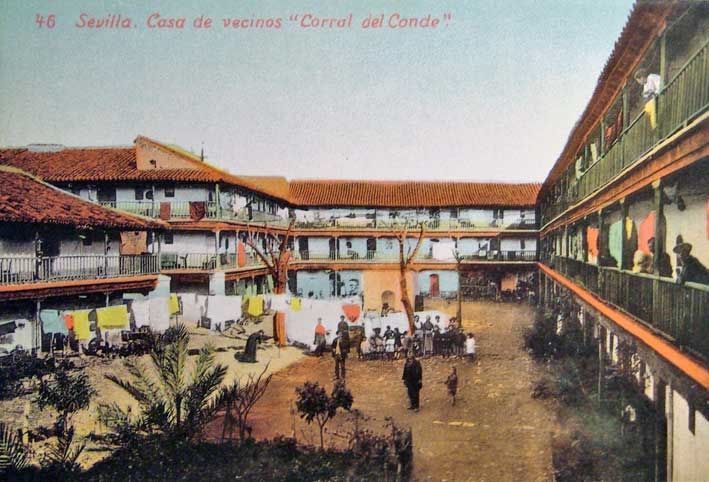
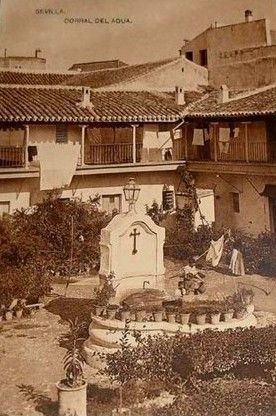
The corral is a type of dwelling that housed a significant portion of Seville's working-class population, and even today, the surviving corrals are occupied by residents of low or lower-middle socioeconomic status. It's important to note, however, that the corral is not only a place of residence but also a space for community life and close social relationships. For this reason, one could even speak of micro-societies that could be studied as distinct communities, even though they have now lost most of their defining characteristics.
Despite its quiet presence in the life of our city, little has been written that is truly valuable for understanding the role of the corral in the urban landscape. We have some high-quality ethnographic and, to a lesser extent, architectural studies, but most of what has been published on the subject remains a collection of colorful and folkloric notes that contribute little. And, apart from the renowned work of Morales Padrón, there are hardly any studies that invite citizens to discover this "inner city" that remains unknown to most, but which is just as valuable as the streets and squares of daily life.
The authors of this work, alarmed by the almost irreversible deterioration of our heritage and aware of its historical value, decided some time ago to undertake the photographic cataloging of Seville's courtyards. Our purpose was twofold: firstly, to create an image archive of this unique urban habitat that would tentatively serve to preserve its memory in the face of the imminent disappearance of many of them; and secondly, to bring them to the public's attention as one of the overlooked treasures of Seville. In other words, it was a matter of raising awareness among the people of Seville about the importance of the courtyards and the need to rehabilitate most of them for their definitive integration into the city's historical fabric.
Thus, using extensive newspaper and bibliographic resources, photographic reports were compiled during 1987, 1988, and 1989 for the vast majority of the courtyards existing in the old town and the historic suburbs (Triana and San Bernardo). Reports were also made of tenement houses and communal buildings, various examples of vernacular architecture, and other buildings of interest that were in danger of disappearing and/or lacked adequate photographic documentation.
We have not aspired to carry out a scientific study; we only intend to bring citizens closer to their immediate surroundings through images, encouraging their participation in decision-making processes that affect the urban values of Seville and raising awareness of the universally accepted need to respect and rehabilitate the historical fabric of our cities.
From the large number of courtyards photographed, we have selected 22 for this catalogue (those marked with an asterisk). This was a difficult task, involving architectural, historical, social, and aesthetic criteria, to create a sample that we believe is representative, though not unique. The poor condition of some of the buildings shown is evident, even the complete abandonment of some, a situation all too common today. An inventory of courtyards is included, encompassing buildings of very diverse types, many of which do not fit the archetypal model of the tenement courtyard. But Sevillian architecture is always difficult to categorize, and we have not hesitated to offer the reader a series of addresses that will undoubtedly surprise them if they haven't yet been demolished. We conclude this humble publication with a commentary on the existing bibliography on the subject.
The tenement courtyard is in clear decline, mainly due to real estate speculation, the rising standard of living, the aging of residents, depopulation and displacement from historic areas, and institutional neglect of historical heritage. A large percentage of the approximately 190 courtyards that survive in Seville (1990) are in poor condition; many are almost uninhabited or in ruins. A few are in perfect condition and house as many of their residents as possible, and it is here that some continuity of traditional life can still be observed. Others have undergone significant restoration that has restored their former splendor, but has replaced their population with a younger one of higher social standing.
The list below, when published back in 1990, was not intended to be exhaustive. In fact, almost all abandoned or dilapidated corrals at the time of its cataloging (1990) were excluded, and only the most representative ones were included in the inventory. Today, however, we have chosen to include practically all of the buildings studied then because, quite simply, most of them no longer exist. Even so, it is possible that many more will disappear in the immediate future, so it is very likely that the reader will find nothing but a vacant lot or a new building instead of the corral they expected. This has been the case since the catalog was compiled, but indiscriminate demolitions have increased frenetically since Alfredo Sánchez-Monteseirín became Mayor of Seville in 1999. Where possible, we have tried to group the streets by area to make it easier to plan a route for visiting the buildings that are still standing. Addresses marked with an asterisk indicate that the corral in question was featured in the photographic catalogue published in 1990.
Old Town
- San Clemente, 11.
- Virgin of Joy, 3 (*).
- Archeros, 7.
- Archeros, 12.
- Archeros, 15.
- Nardo, 4.
- Nardo, 5.
- Dyes, 12.
- San Esteban, 22 (*).
- Santiago, 25 (Corral del Conde) (*).
- Gerona, 36-38 (Corral de la Sardina).
- Jerónimo Hernández, 28.
- San Felipe, 14 (*).
- Conquest, 4.
- Navarros, 40 (La Tarazana).
- Piarist Schools, 11A-11B-13.
- Alhóndiga, 24.
- Leoncillos, 7.
- Matahacas, 31.
- Matahacas, 41.
- King's Rod, 8 (Corral de la Corona).
- Valley, 7.
- Silk Art, 17.
- Santa Clara, 47.
- Santa Clara, 55.
- Santa Clara, 72.
- Calatrava, 4.
- Lumbreras, 27.
- Alameda de Hércules, 95 (*).
- Blanquillo, 4.
- Rest, 5.
- Faustino Álvarez, 63.
- San Juan de la Palma, 20.
- Alcázares, 5-7-9 (Corral del Coliseo).
- Jerónimo Hernández, 28.
- Peral, 27.
- Fair, 110.
- Feria, 135.
- Feria, 140.
- Dock, 13-15.
- Bajeles, 11.
- Bajeles, 16-18-20 (*).
- Alfaqueque, 18.
- Alfaqueque, 20.
- Rubens, 8.
- Cantabria, 14.
- Goals, 15.
- Jesus of Great Power, 119.
- Jesus of Great Power, 124.
- San Juan de Oviedo, 1-3 (Corral de Esquivel) (*).
- Santa Ana, 22-26 (Palace of the Infantado).
- San Vicente, 98.
- San Vicente, 100 (the Big House or San Vicente corral) (*).
- San Luis, 16.
- San Luis, 47.
- San Luis, 67.
- San Luis, 69 (Valvanera Passage).
- San Luis, 73-75 (Corral de la Parra).
- San Luis, 80-82.
- Heliotropo, 3.
- Castellar, 12.
- Laurel, 6.
- Admiral Espinosa, 6.
- Admiral Espinosa, 10.
- Santa Marina, 6-8.
- Santa Marina, 22.
- Santa Marina, 28.
- Divine Shepherdess, 4.
- Divina Pastora, 9 (*).
- Divine Shepherdess, 49.
- Plaza del Cronista, 8.
- González Cuadrado, 18 Dpdo.
- González Cuadrado, 46.
- Arrayán, 17.
- Virgin of the Underground, 5.
- Pedro Miguel, 16.
- Pedro Miguel, 34.
- Clavellinas, 5.
- Innocents, 21.
- Escoberos, 25.
- Bitterness, 9.
- Macarena, 6 (Corral del Crimen).
- Macarena, 8.
- Macarena, 14.
- Torrijiano, 16.
- Morera, 9 (Corral de la Morera).
- Torreblanca, 16.
- Court, 10.
- Court, 17 (Old Courthouse) (*).
- Wallets, 12.
- Macasta, 8.
- Macasta, 23.
- Macasta, 25.
- Hiniesta, 42 (Corral de los Muertos).
- Hiniesta, 47 (House of Ismael).
- Lira, 10 (Casa de la Parra).
- Lira, 15.
- San Hermenegildo, 8.
- Sun, 92.
- Sun, 122.
- Sun, 136.
- Bricked, 13.
- Bricked, 35 (*).
- Bricked, 41.
- Bricked, 45.
- Bricked, 59.
- Friar Diego de Cádiz, 2.
- Friar Diego de Cádiz, 18.
- Friar Diego de Cádiz, 31.
- Friar Diego de Cádiz, 38.
- Parras, 11.
- Parras, 22.
- Parras, 31.
- Lagares, 22.
- Bathrooms, 8.
- Stone Man, 8.
- Rapporteur, 58.
- St. Mark's Square, 1.
- Well, 10.
- Sagunto, 5.
- Jimios, 22 (Corral de San José).
- Gandesa, 2.
Triana
- Pagés del Corro, 1 (El 1 de la Encarna).
- Pagés del Corro, 5.
- Pagés del Corro, 47.
- Pagés del Corro 50 (Corral de Sanchez) (*).
- Pagés del Corro, 93.
- Pagés del Corro, 95.
- Pagés del Corro, 103 (Corral or house of the Virgin of Rocío).
- Pagés del Corro, 111 (Corral or Herrera flats).
- Pagés del Corro, 128 (Patio de la Encarnación).
- Pagés del Corro, 161.
- Pagés del Corro, 176 (Casa de los Guardias).
- San Jacinto, 34 (Former House of Charity).
- San Jacinto, 60 (Corral del 90).
- San Jacinto, 62 (Barea Flats).
- San Jacinto, 77.
- Saint George, 19.
- Pureza, 98 (*).
- Pelay Correa, 13.
- Pelay Correa, 35-37-39.
- Pelay Correa, 59.
- Rodrigo de Triana, 8.
- Rodrigo de Triana, 74.
- Castile, 7.
- Castilla, 16 (House or Courtyard of Flowers) (*).
- Castilla, 58 (Corral de los Fideos) (*).
- Castile, 65.
- Castile, 75.
- Castilla, 88 A (Corral de la Rana) (*).
- Castile, 105.
- Castile, 110.
- Castile, 128.
- Castile, 141.
- Castile, 143.
- Castile, 158 (The High House).
- Callao, 8.
- Clara de Jesús Montero, 28 (Hotel Triana).
- Pottery, 4.
- Pottery, 8 (The Big House).
- Pottery, 19.
- Pottery, 32 (The Beautiful Fence).
- Pottery, 49.
- Pottery, 69.
- Pottery, 85-87 (El corral Largo) (*).
- Pottery, 119 (Corral del Naranjero) (*).
- Pottery, 138 (Corral de los Corchos).
- Pottery, 144 (La Casilla to Corral del Trágala).
- Covadonga, 5.
- Bernardo Guerra, 5 (El Jardincillo).
- Squirrel, 9 (Guards' House).
San Bernardo
- San Bernardo, 6-8-10.
- San Bernardo, 27.
- San Bernardo, 57 (Corral de las Cureñas) (*).
- Camp, 27 (Segundino's House).
- Camp, 29.
- Camp, 35 (The Painted Oven) (*).
- Camp, 41 (El Jardincillo) (*).
- Remember, 6.
- Enramadilla, 1 (Corral de “El Minuto”).
- Santo Rey, 14.
- Alonso Tello, 8 (Casa de los Canarios).
- Marqués de Estella, 10 (Casa del Carbonero).
- Gallinato, 14.
- Valme, 10 (Corral de Santa Justa).
Ensanche
- Progress, 27 (The Barracks).
- Luis Montoto, 37 (Casa de los Escalones).
- San Benito, 10.
Source: «Corrales de Sevilla. Photographic Catalogue» by Jordi Tarrés Chamorro (Photography and design) and Ignacio Benvenuty Cabral (Research, catalogue and texts). Self-published. Seville, 1990.