

Comedy Courtyards
Just as a great theater of national significance had made its brilliant appearance in Elizabethan England, a dramatic art with powerful and specific characteristics emerged in Spain during its Golden Age. However, in this historical period so decisive for world theater, and in which numerous and important dramatic poets flourished, from Juan de Encina to Calderón, the venues where their plays were performed (as was also the case in England with those of Shakespeare and his contemporaries) were rudimentary structures, their simplicity almost always closely linked to poverty.
The evolution of the "theatrical venue" in 16th and 17th century Spain can be divided into two stages, which are sometimes confused. The first of these stages, as in other countries, is that of the traveling wagons, the traveling players, a kind of minstrel with a distinctly medieval character; and the second stage is that of the rise of the corrales, neighborhood courtyards adapted for performances.
The traveling players journeyed and performed in groups of varying sizes, visiting hamlets, towns, and villages in constant motion. These groups were known by different names, depending on the number of members and the genre they most frequently performed. Aside from the so-called bululú, composed of a single minstrel who played all the roles by changing his voice intonation and using expressive mime, the main theatrical groups were: the ñaque, made up of two actors; the gangarilla, with three or four actors and a boy playing the leading lady; the cambaleo, with five men and a woman who sang; the garnacha, with five or six men, a woman playing the leading lady, and a boy playing the second leading lady; the bojiganga, with few members, which performed religious plays and comedies in small towns; and the farándula, with seven or more men and three women. Gradually, some of these groups became sedentary, settled in specific cities and corrals, and received the now modern name of companies. A typical company consisted of sixteen actors, plus fourteen substitute or supernumerary comedians.
As the Royal Catalogue of Spain testifies, numerous companies wandered the peninsula in their humble carts during the 16th and 17th centuries. They performed plays by Juan del Encina, Gil Vicente, Lucas Fernández, Lope de Rueda, Juan de la Cueva, and others. Such was their success that Nebrija himself speaks of the pleasure he derived from hearing the verses recited by the actors; a pleasure far greater than that of reading them. The most unsophisticated and primitive people, illiterate peasants, and the least educated villagers attended the sporadic theatrical performances in streets and squares, towns and villages, with the same enthusiasm as the educated citizens.
This general success of public performances was undoubtedly one of the main reasons that led to the creation or improvisation of more suitable and permanent venues for them. These venues soon proliferated throughout Spain. As early as 1526, a permanent theater existed in Valencia: the Corral de la Olivera or Vallcubert, whose profits were used to maintain the hospital. It was located in a district of brothels and taverns, and consisted of a courtyard with a crude stage and an adjoining shack. This building was known as the “House of Performances and Farces.” Admission cost 4 deniers to stand and 7 to sit.
Barcelona had its first corral de comedias (open-air theater) on the Ramblas, on the site of the former Principal Palace, where performances were already taking place in 1581. Valladolid boasted the Corral de la Puerta de San Esteban (1575). In Toledo, the Mesón de la Fruta opened in 1576, and a small theater was built in the Coso of Zaragoza in 1589. Granada's corral was located in the Mesón del Carbón, or Casa del Carbón (1583), and Córdoba's in the Cárcel Vieja (1587). As for Madrid, the first six corrales de comedias inaugurated were the following: two on Calle del Príncipe (probably in 1562 and 1563); the Corral de la Pacheca (1574), the Corral de la Cruz (1579), the Corral de la Calle del Lobo, also called the Corral de la Puente (1566), and the Corral de la Calle del Sol (1565).
The plays began around five in the afternoon and were sometimes preceded by a prologue or interlude. It is known that comedies were performed at the wedding of the Infanta Maria to Archduke Maximilian, celebrated in Valladolid, among them perhaps one by Ariosto. The itinerant life of Charles I deprived the court of a permanent structure, and this had a significant impact on theatrical art.
Secular plays were performed not only in theaters, but also in churches and convents. Great lords even set up stages in the halls of their palaces and mansions. To counter the hostility of the austere theologians, the idea of staging plays about the lives of saints spread, and the custom of using the proceeds for pious purposes continued.
The works of Lope de Vega, this prodigious author of 1,800 comedies and 400 autos sacramentales, gave considerable prominence to Spanish theatre, which reached its literary peak at the end of the century.
It can be stated that the first performance in Madrid “in a corral” was given by the acclaimed comedian Alonso Velázquez on Wednesday, May 5, 1568.
After Madrid, Seville, the wealthiest city in Spain during the 16th century, had the greatest passion for theatrical performances, boasting numerous open-air theaters. The oldest of these was the Atarazanas, where, between 1579 and 1581, two plays by Juan de la Cueva were performed: “The Freedom of Spain by Bernardo del Carpió” and “The Freedom of Rome by Mucius Scaevola.” The leading roles were played by Pedro de Saldaña and Alonso de Capilla, respectively. Another of Seville's open-air theaters was the San Pedro, mentioned by Rodrigo Caro in his Antiquities of Seville, and located on the hill of San Pedro.
The performances in these open-air theaters unfolded as follows: first, the company's guitarist, vihuela in hand, played some popular tunes. This was immediately followed by singing—one or two voices—accompanied by various instruments, whose players were positioned in a semicircle on the stage. The singers remained behind the curtain. Next came the prologue, an essential introduction to any theatrical work, recited by the company's director. Afterward, the comedy, during whose intermissions there were short farces or dances with castanets.
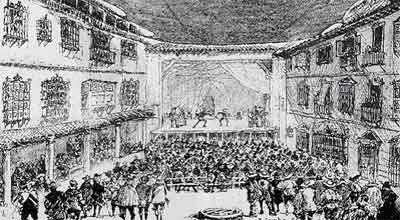
The corrales were courtyards that opened onto neighboring houses. The windows of these adjoining buildings, usually fitted with grilles and latticework according to Spanish custom, served as boxes, their number having greatly increased compared to the original number. Those on the top floor were called attics, and the ones immediately below, parlors—a truly generic term that was sometimes also applied to the former. These windows, like the buildings they were part of, belonged to different owners, and when the confraternities did not rent them out, they remained at the disposal of those owners, although with the annual obligation of paying a certain sum to enjoy the spectacle. Some of the adjoining buildings, and generally most of them, belonged to the confraternities. Below the parlors was a series of seats in a semicircle, called bleachers, and in front of these was the spacious, open courtyard, from where the lower classes watched the spectacle standing. This group of spectators, due to the commotion they caused with their noisy demonstrations for or against comedies and actors, were called musketeers, undoubtedly because their uproar resembled volleys of musket fire. In the pit and near the stage, there were rows of benches, probably also open to the elements like the pit, or at most sheltered by a canvas awning. A kind of shed protected the stands from the weather, and the musketeers took refuge there in rainy weather; but if the theater was too full, there was no other option but to suspend the performance.
Initially, no separate area was designated for women; later, a century later, a section was built for the lower classes at the back of the courtyard, called the "cazuela" or the women's corridor. The leading ladies occupied the apartments or lofts. Besides these main divisions of Spanish theaters, we must also mention some others whose exact location cannot be determined, namely: the railings, the small corridor, the "degolladero" (the area around the entrance to the theater), and the "alojeros" (the refreshment stands). The latter name referred to a place where a type of drink called "aloja," made of water, honey, and spices, was sold. Later, a box was added above the "cazuela" for the Mayor who presided over the performance. In earlier times, the Mayor's seat was located on the stage.
Source: "Principles of Theatre" by Can Fusté