

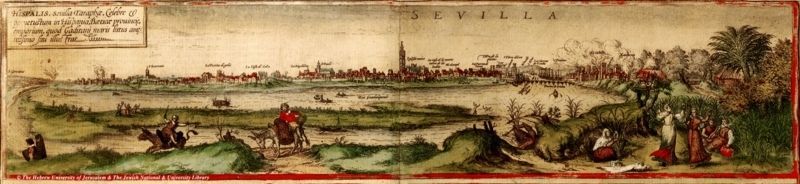
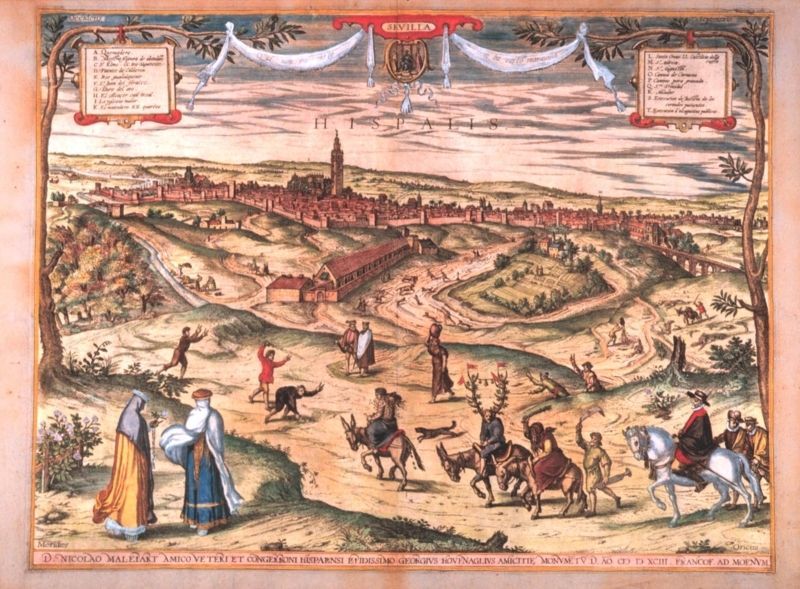
Seville in the 16th century
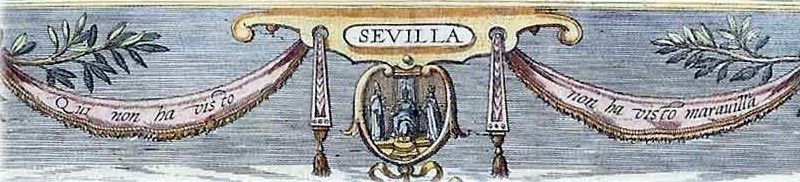
Many engravings of Seville from the 16th and 17th centuries bear the motto: "He who has not seen Seville has not seen a marvel." This is the image of the city disseminated by European engravers and travelers, joined by national writers such as Luis de Peraza, who wrote the first History of Seville in 1535.
The truth is that since the establishment of the House of Trade of the Indies in this city in 1503, to which must be added the wedding of Emperor Charles V in 1526, Seville became an international center of attraction, which Gil González Dávila, as late as 1647, referred to as:
"A court without a king. Dwelling place of the great and powerful of the kingdom and of a great multitude of peoples and nations… composed of the opulence and wealth of two worlds, Old and New, who come together in its squares to discuss and address the sum of their affairs. Admirable for the happiness of its minds, the temperance of its air, the serenity of its skies, the fertility of its land…"
But let's take a closer look at the city during the era that saw the birth of its University, its people, and its institutions—undoubtedly Seville's finest period, which we could well call the "Silver Age," not the Golden Age, since that metal flowed in greater quantities through the port and the city, the gateway to the Indies. For good reason, Lope de Vega wrote in a seguidilla: "Silver ships come from Sanlúcar, breaking the water, to the Torre del Oro."
In general, the street layout of Seville in the 16th century retained the character of the Islamic period, sustained in many areas of the city by the presence of ethnic minorities—Moriscos and Jews—whom the laws sought to isolate in certain parishes. Sixteenth-century Seville was nothing other than the product of the transformation of Islamic urban planning superimposed on the Roman-Visigothic foundations. Well into the century, houses continued to present modest facades, as the Muslim house was oriented inward.
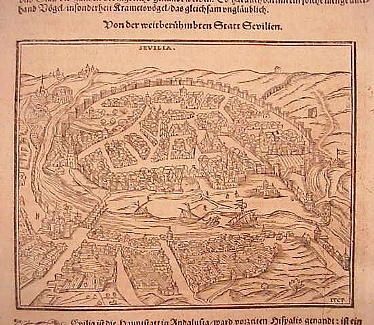
But the Renaissance spirit brought from Italy ideas about the monumentality of buildings, their perspectives if they were public, wide and straight streets, etc. Many royal decrees aimed to eliminate narrow passages and projections in the streets, which were to be wide and sunny. Public buildings were constructed freestanding and monumental.
The 16th century is the quintessential century of monuments in Seville; the most important buildings in the historic center date from this period: the Cathedral (completed in 1506), the Lonja/Archivo de Indias (1584-1598), the Giralda (bell tower and Giraldillo: 1560-1568), the City Hall (1527-1564), the Hospital de las Cinco Llagas (1544-1601), the Church of the Annunciation (1565-1578), the Audiencia (1595-1597), the Casa de la Moneda (1585-1587)... The new aesthetic-architectural-urban planning patterns allowed Seville to demolish overhangs, small arches and ajimeces (balconies) in order to eliminate dampness and introduce sunlight into the urban arteries.
But in Seville, it was difficult to establish regularity and symmetry in the urban layout because it lacked a comprehensive urban plan like the one we have today. Thus, Seville's streets remain narrow, crowded with pedestrians, horses, rubbish, rubble, stalls, and so on. Navigating the commercial streets and squares, filled with stalls, makeshift structures, and portable counters, was a real challenge.
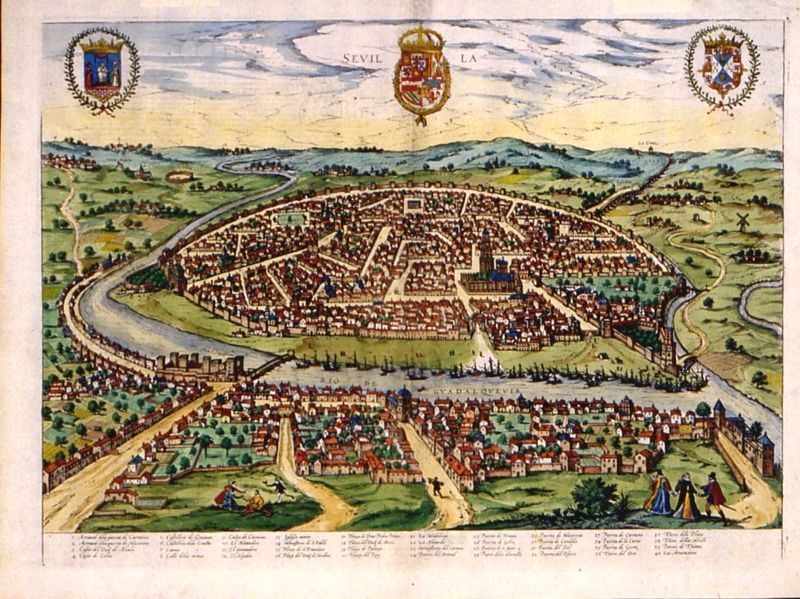
In the 16th century, Seville retained its almost round shape, "although some ancient people of our country - as Mal Lara writes - gave it the shape of a lance, with the point being the Macarena gate and the eye through which it is pointed, the postern of the Alcázar, and the wide sides, the Carmona gate and the side of the River."
The irregular layout of the streets was fundamentally due to a utilitarian approach: straight streets weren't needed since there was no wheeled traffic yet, and their winding paths facilitated defense against internal threats. The narrow streets were simply thoroughfares, their narrowness and the awnings protecting the inhabitants from the harsh summer sun. For socializing and gathering, there were plazas and other wider streets where shops were located, particularly near the religious and political center. Chroniclers of the time, such as Luis de Peraza, describe "wide and sunny" streets like the one that began at the Puerta de la Macarena, or Sierpes and San Vicente. (Clearly, the concept of width at that time is not the same as today's, judging by these still-existing streets.)
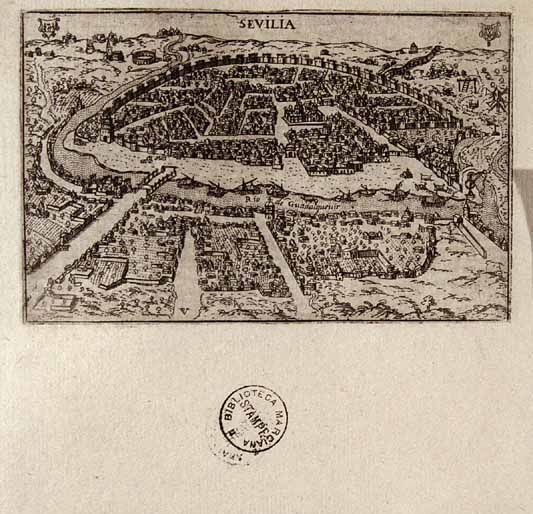
However, the Christians did introduce something innovative to the city: the plazas. The city was filled with them in front of churches, palaces, and public buildings, although they weren't as large as in other parts of the Iberian Peninsula. The quintessential Sevillian plaza was the Plaza de San Francisco, entirely arcaded, with a fountain at one end. It was the city's grand stage, surrounded by important buildings: the City Hall, the Royal Court, the Convent of San Francisco, and the Royal Prison. But the largest of the plazas, a natural one, was the Plaza de la Laguna, which Don Francisco de Zapata, Count of Barajas, developed in 1574, planting numerous poplar trees. From then on, it was known as the Alameda de Hércules, after the two Roman columns erected at its end, topped with statues of Hercules (the mythical founder of Seville) and Caesar (the supposed builder of the city walls).
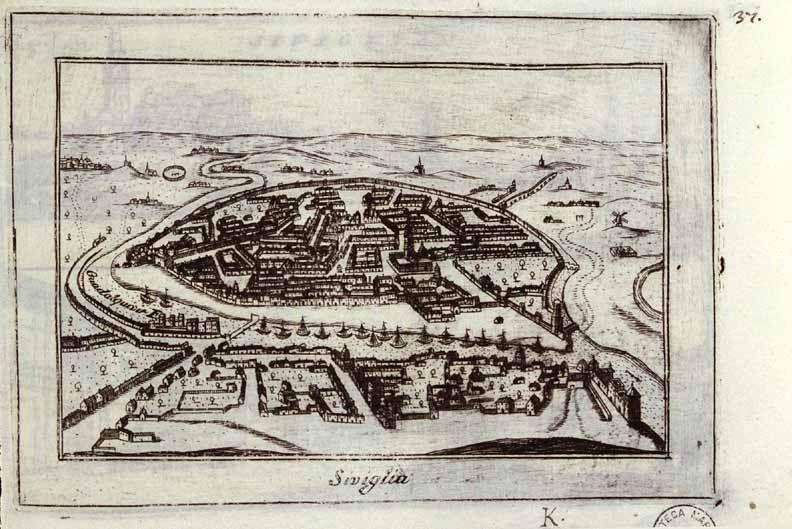
The city's cleanliness left much to be desired. Garbage in the streets was a widespread problem. People were accustomed to throwing their waste into the street, along with construction debris, digging holes, dumping dirty water, and so on. Municipal edicts prohibiting the dumping of dead animals, manure, water, rubble, and refuse along the city walls and the Arenal area were issued throughout the century almost as frequently as residents' requests and the repair of potholes as festivals approached. In the Arenal area stood the Malbaratillo Hill, formed from the garbage and filth that the surrounding residents had been throwing there since ancient times.
The cobblestones and brickwork of the squares and streets were chronically riddled with ruts caused by the passage of animals and carts. In the plazas, where people, animals, and carts gathered for the market, potholes and piles of manure were constant. Puddles in winter and dust and foul odors in summer were unbearable. The Plaza de San Francisco itself was the subject of a proclamation from the City Council ordering residents to clean it under penalty of 1,000 maravedís; it got to such an extreme that it was impossible to walk or ride a horse. On other occasions, it was the residents, with the parish priests acting as their spokespeople, who demanded the removal of the city's filth. Domínguez Ortiz counted as many as eight streets named "Dirty," not because the others were clean, but because the filth was more pronounced than in the others.
At the end of the century, the situation seemed to remain the same or worsen; in 1594, Philip II issued a royal decree appointing four constables to inspect and clean the city of Seville. Ariño indicates that in 1597, anyone who threw dirty water or soapy water out of their windows into the streets was punishable by ten days in jail and a fine of 20 maravedís if they were a slave or servant. However, in the city council meeting of March 5, 1598, a lieutenant of the city council stated: "It is shameful to see how ruined the city is, with filth and piles of garbage in all the squares and streets, which are practically garbage dumps."
The unpleasant odors were combated in houses with abundant vegetation. The famous chronicler of the time, Peraza, recounts up to 210 orchards and gardens, among palaces and convents, which occupied large plots within the town limits. He describes a total of 12,000 dwellings in the town, each with brick-paved patios, gateways, and wells; the patios were filled with fragrant plants and potted plants, and the gardens featured pergolas adorned with jasmine, rose bushes, citron trees, orange trees, myrtle, and other plants and flowers.
Water was brought to the city via the Arab Carmona aqueducts (1) and thanks to a number of nearby springs, such as the Archbishop's spring, the Martín Tavara spring, and some in Alcalá de Guadaira. In the houses where water did not reach—the majority—wells and cisterns were used, and waterwheels were employed to irrigate the orchards and gardens. There were also numerous public fountains, probably around 300.
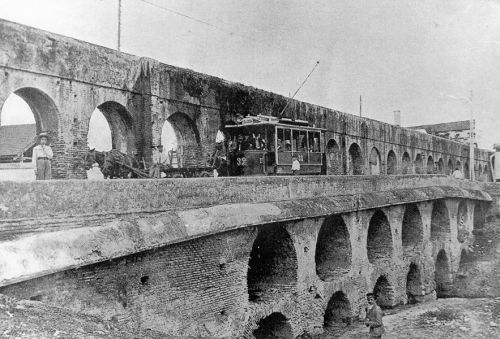
"Throughout the city as a whole, so many springs are derived from the Carmona pipes and the Archbishopric's aqueducts that there is hardly a main house that does not have them, with many orchards and gardens: which, with other provisions, in the hottest summer, together with the gentle tides that usually run, make the city remarkably peaceful, cool and delightful." Rodrigo Caro (1573-1647).
"There is plenty of drinking water in Seville and an aqueduct of three hundred and ninety arches, some duplicated by an upper section, to overcome the slope of the land; a great quantity of water flows through this structure and provides a very good service for the irrigation of gardens, cleaning of streets and houses, etc." Jerónimo Münzer (1495).
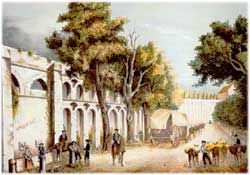
As Morales Padrón masterfully summarizes: “Seville in the 16th century remained enclosed and irregular. Enclosed by its walls and the enclosedness of its houses; enclosed by its women, veiled in the Moorish style; and irregular in its cosmopolitan life, in the layout of its streets, and in the shapes of the city blocks made up of houses whose facades were not parallel. It is not possible to make a radical break and say: here ends the Islamic city and begins the Christian one. However, several centuries separated Islamic and Christian Seville; but the similarities were still evident. Not only because one was a continuation of the other, but also because of the way of life.”
Sixteenth-century Sevillian houses offered several types: those of the wealthy or the humble, the tenement courtyard, and the palace. The Ordinances of Seville, compiled in 1527, though much older in reality, describe the different types of houses required by custom.
Common house, which had a porch, living room and the apartments that "the lord (the owner) demanded"
Main house, with halls, stables, chambers and bedrooms, porches, patios and reception area
Royal House, with similar dependencies, of "all members belonging to the house of a king, prince or great lord".
They were made with rammed earth, adobe, bricks, and stone. Regarding the exterior appearance of urban houses, Morgado points out that before the 16th century, "all construction (in Seville) was done inside the houses, without regard for the exterior," it being a novelty that in his time (1582) they were already being built "facing the street."
For a long time, Christians continued the Muslim custom of neglecting the exterior of their houses and focusing their attention on the interior, where light enters through patios, gardens, and courtyards. The central patio, as a fundamental element of the layout, is so characteristic of Spain that foreigners call it "Castilian-style," which many consider a derivative of the Moorish house. In the opinion of the architect Vicente Lampérez (1861-1923), this opinion seems unfounded. In the "Castilian-style" house, the entrance is direct, through a vestibule; in the Moorish house, the entrance is always lateral, through a winding vestibule with one or two turns, which isolate the interior from the exterior.
Documents and chroniclers mention the corrales, communal dwellings of Arab origin. They were maintained in 16th-century Seville, perhaps due to rapid population growth, "for people who could not afford so much," as Alonso Morgado stated in 1582. This chronicler mentions one of them as having 118 residents, which gives an average of about 470 inhabitants.
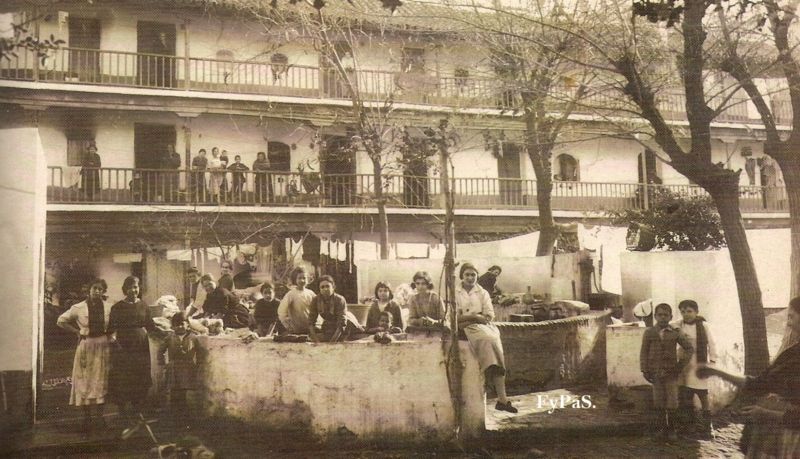
The courtyard, like the alleyway or cul-de-sac, could be enclosed, guaranteeing nighttime safety and isolating its inhabitants from street inconveniences such as noise and filth. For non-Christian ethnic minorities, the courtyard and the alleyway were good refuges. Poor Christians also found shelter in the courtyard, making its patio a special center of community life; the patio was the main square, a place for all kinds of activities, including brawls, games, and shouting—a veritable "inner city."
Towards the end of the century, with the rise of trade with the Indies, the city's housing stock improved considerably. With increased income and population, house construction surged; between 1561 and 1588, more than 2,454 new houses were built in Seville, primarily in Triana (900) and San Vicente (742). In 1570, the chronicler Juan de Mal-Lara noted that the city was very different from the one the Venetian ambassador Andrea Navajero had seen in 1526 when he came for the Emperor's wedding. As had always been the case, construction was a business rife with speculation and abuse, as some appropriated public lands belonging to squares or streets.
According to Professor Morales, the transformation of Seville's houses must have taken place in the first half of the century, following a Renaissance conception. In 1547, Pero Mexía has his characters say that "for the past ten years, all the residents have been building their houses facing the street, and more windows and grilles have been added than in the previous thirty years." Many low, humble, single-story houses still remained, but this was due, among other things, to the fact that Seville's humid climate favored low, sunny houses on wide streets to combat the dampness carried by the river and floods. This is Mexía's explanation when he justifies the removal of projecting balconies and ajimeces (wooden balconies with latticework) that was taking place at the time. Morgado shares this same view, contrasting the Castilian dwelling with the Sevillian one, which is low, with patios and corridors to allow for fresh air and sunlight. There was another reason for prohibiting the cantilevering of floors: the terrible fires that consumed entire blocks and even huge portions of cities, despite the severe "fire cover" ordinances.
The limits of the capital were defined by the wall, an Almoravid and Almohad construction, which enclosed the city for about six kilometers. Outside the city walls lay its two rivers (yes, two): the Guadalquivir to the west and the Tagarete stream to the east and south; the latter is no longer visible within the city, having been covered over and diverted over the centuries. But in the 16th century, it still represented a barrier to communication with the surrounding countryside.
The wall, made of lime, sand, and pebbles (2), had its barbican (lower outer wall), separated by a moat about three meters wide (still clearly visible in the Macarena district). The wall had between 166 and 200 towers and almost a dozen gates plus three or four posterns: Sol, Osario, Carmona, Carne, Macarena, Triana, Arenal, Real, Córdoba, Jerez, Goles, Bib Johar, Almenilla, and Bibarragel. Of all the towers, the largest and most ornate was the Torre del Oro (Tower of Gold), an albarrana tower (outside the wall line) that allowed for the defense of the river and access to the port.
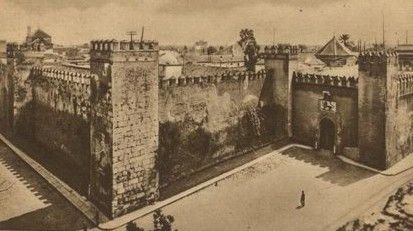
The gates played a crucial role in every sense, even in the sense of security and seclusion that protected the lives and health of the residents at night. Considered sacred, breaking them was punishable by death under the Siete Partidas. The gates opened at sunrise and remained open throughout the day, as many worked outside the city in the nearby fields, mills, vineyards, and orchards that supplied Seville, such as the King's Orchard or those near the Macarena, in port districts like Triana, in convents outside the city walls like those of the Trinity, San Bernardo, or San Jerónimo, and in hospitals like the Hospital de la Sangre or San Lázaro. The flow of travelers through the road gates of Carmona, Córdoba, Macarena, Jerez, or Triana must have been constant. But at dusk, the guards closed the gates without exception.
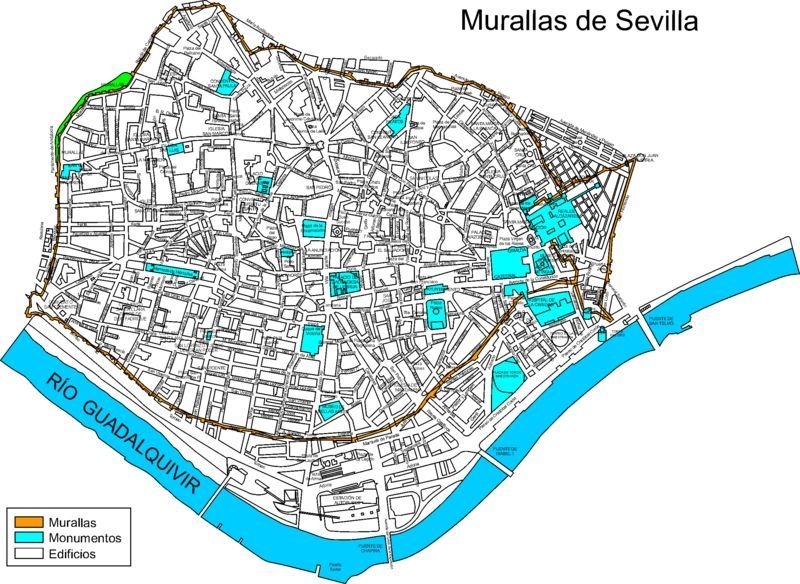
The wall was built for defense against external enemies. From the 13th century, when Seville was conquered by Saint Ferdinand, it no longer served this purpose, although it continued to play an important role in defense against Seville's greatest historical enemy: the Guadalquivir River and its floods. Seventeen floods were recorded in Seville during the 16th century, plus another twenty that partially affected the city walls. For this reason, the walls remained intact until the 19th century. Outside the walls, the waters turned the land into mud and swept away crops and fields, ruining harvests and cutting off communications for weeks. Sometimes, the force of the floods was such that the pontoon bridge was destroyed, isolating Seville from Triana and its surrounding area. The river port, vital to the city's economy, always suffered the brunt of the floods, disrupting customs operations, damaging goods and the warehouses that awaited them, and flooding ships. Sometimes, the flooding of the Guadalquivir was increased by the waters of the Tagarete, the other riverbed that bordered the city to the east and south.
Furthermore, in European cities, city walls acted as a sanitary cordon, isolating them from the diseased outside world during epidemics. Seville was no exception. As soon as news of a contagious outbreak reached them, guards were posted at the gates to ensure that those entering did not come from infected areas. Once the decision was made to prevent contagion, the city was sealed off.
Its state of preservation in the 16th century appears to have been very good; a chronicler of the time recounts that "in some parts the walls are almost so new and intact that they seem to have just been finished." However, its loss of defensive value led to its surroundings being very neglected. Buildings were added to it, and in other places, rubbish accumulated in enormous quantities.
Such was the accumulation of garbage that Hernando Colón built his magnificent house-library in the Humeros neighborhood on top of one of these refuse heaps in 1526; the house stood above the city wall, so high was the refuse heap that it almost reached the height of the walls. According to recent archaeological studies, such unstable foundations and the flooding of the nearby river must have caused its collapse after the flood of 1603.
Within the city walls—or outside them in the suburbs—the population lived grouped in parishes. These, like the Islamic neighborhoods and suburbs, consisted of a cluster of houses and residents surrounding a church, which could function independently. Within the parish or on its periphery were located neighborhoods characterized—as in the Muslim case—by an economic or bureaucratic activity, or by an ethnicity or nationality (coopers, coopers, Franks, Catalans, etc.).
In the first part of the 16th century, Seville had 27 parish churches and two exempt jurisdictions; at the end of the century, two new parishes outside the city walls (San Bernardo and San Roque) were added, and the exempt jurisdictions disappeared. Almost as in Moorish times, the alcaicerías, neighborhoods where specialty goods were sold, were maintained and developed; there was the Alcaicería de la Seda (Silk Market), between the Puerta del Perdón (Gate of Forgiveness) and the Plaza de San Francisco; further on, between Sierpes and Francos streets, lay the area simply known as the alcaicería, which acquired great importance in this century due to trade with the Indies.
The city was not spared a series of calamities that frequently disrupted urban life. Earthquakes, droughts, floods, hurricanes, famines, plagues, fires… were veritable curses. In 1533, a great fire broke out in the Campo de Tablada; in 1562, another destroyed a number of ships anchored in the river; in 1579, the Triana gunpowder factory exploded, killing 200 people and destroying as many homes.
Floods were a constant occurrence that forces us to place the Guadalquivir River as the backdrop to Seville's history. Floods are recorded in 1503, 1507 (both of which destroyed the pontoon bridge), 1510, 1523, 1543, 1544 (a sudden flood caused ships to enter the city through the Azacanes gate), 1545 (another sudden flood swept away the bridge and two hundred houses in Triana), 1549, 1554, 1586, 1591, 1592 (boats traveled through the streets of the Carretería district), 1593, 1594, 1595, 1596, and 1597.
At other times, it was the lack of water that caused famine and misery. There were major droughts in 1522, 1540 (when the Virgin of the Kings was taken out in procession and it rained), 1560, 1561, 1562, and 1571.
To conclude this brief overview of 16th-century Seville from a Sevillian's perspective, we cannot disregard the opinions of foreign travelers of the time, who were generally few throughout most of the century. Among the negative views of Spain and Andalusia, we find the Italian Guicciardini, who, at the end of the 15th century, said of the Spanish: "They consider commerce shameful; the great poverty of the country is not due to its qualities but to the laziness of its inhabitants; they send raw materials abroad to be processed there; they live in miserable houses, and what they have to spend they spend on themselves or on a mule carrying more than they have left in the house."
Of the Andalusians he will say: “They are of a sober character and proud by nature, without, in their opinion, any other nation being comparable to them; in their speech they are very exalted about their own affairs and are ingenious in pretending as much as they can;…They are perhaps more inclined to arms than any other Christian nation and have great aptitude for them, because they are of agile stature and very skillful and light of arm. In arms they greatly value honor, so that, in order not to stain it, they are not concerned, in general, with death.”
He certainly hasn't spared any criticism, although he acknowledges that "there are some beautiful cities, such as Barcelona, Zaragoza, Valencia, Granada, and Seville." He must have a point, as we'll see elsewhere, regarding the lack of enthusiasm for manual labor, something considered dishonorable at the time.
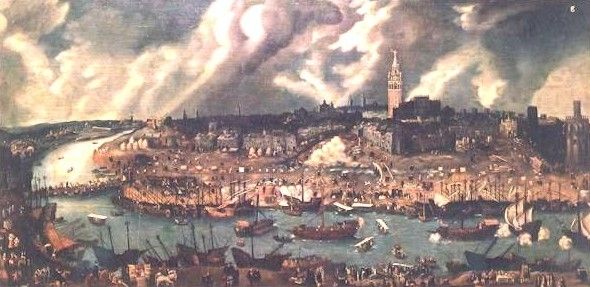
But there were also positive accounts, such as that of the German Jerónimo Munzer, who traveled through Spain between 1494 and 1495, also known by the Latin name Hieronymus Monetarius. Of Seville he said: “city of the most famous kingdom of Andalusia, known in Latin as Hispalis, situated on a vast and beautiful plain, larger than any other of the Spanish cities I visited, and whose countryside produces in prodigious abundance all kinds of fruit, especially oil and excellent wine. I saw the city from the very high tower of the Cathedral, formerly the main mosque, and it seemed to me twice the size of Nuremberg; its shape is almost circular; at the foot of its walls to the west flows the Guadalquivir, a large and navigable river, which at high tide rises three or four cubits, carrying slightly salty water, while at low tide it becomes very fresh.” Besides this, Seville has plenty of drinking water and an aqueduct with 390 arches, some of which are doubled by an upper section to overcome the uneven terrain; a large quantity of water flows through this structure and provides excellent service for watering gardens, cleaning streets and houses, etc. The city also has fine monasteries of Franciscans, Augustinians, Dominicans, and convents of nuns.
No less interesting is the description of the river and its port made by Diego Cuelbis in 1599, during his travels through Spain: “Seville is one of the noblest and richest cities in Spain. Capital of the Kingdom and Province of Andalusia. It is a very peaceful, flat, and cheerful city, full of noble people and old houses. It is situated on the banks of the Guadalquivir River, formerly called the Betis, which is so wide and deep there that enormous ships of four hundred, five hundred, and more tons can easily reach the city. It is one of the most important ports in Spain, from which every year great fleets and ships or galleons depart for the West Indies, laden with all kinds of merchandise, so that the main trade with the West Indies is centered in this city. Almost all nations trade here: Germans, Flemish, French, Italians.”
Source: «History of Seville in the 16th century» by Alfonso Pozo Ruiz.