


Origin of the Corrals
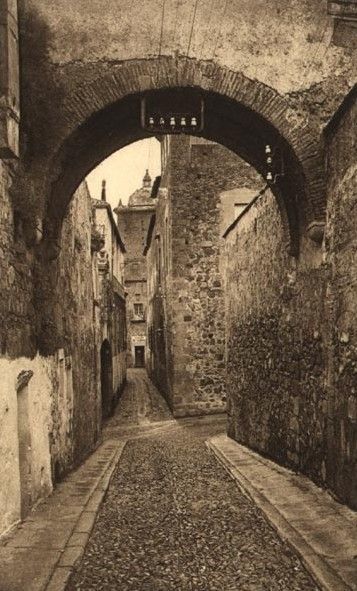
The Andalusian courtyard house (corral de vecinos) has its origins in the Arab adarves—dead-end alleyways with a single entrance—and more specifically in the Mozarabic curralaz—a courtyard onto which the doors of the houses opened. Historical records of its existence date back to the 14th century, and more precisely to the 16th century. It was during this period that they experienced significant development, especially in Seville, due to its status as the exclusive port of entry and exit for the Indies. The architectural model that emerged during this era has been preserved to this day and has greatly contributed to shaping the life and urban landscape of Seville and other Andalusian cities.
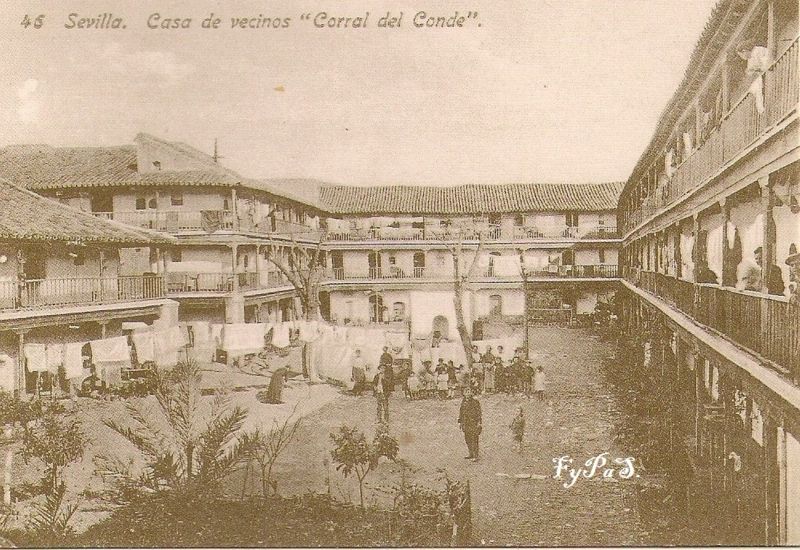
The Andalusian tenement courtyard, and especially the Sevillian one as described to us by Luis Montoto y Rautenstrauch in 1882, was a "courtyard, more or less spacious, in the center of which stands a fountain or sinks a well: a fountain or well that serves the residents, who use its water for all aspects of life, provided the pipes and rainfall allow it; four corridors that circumscribe the square of the courtyard, and in them as many doors as there are rooms – 'rooms' – on the ground floor, as well as a small corner designated for the disposal of refuse and a much smaller patio – a small courtyard – dedicated to washing, when these are not in the courtyard itself. The upper part of the building corresponds exactly to the lower. Each resident, or rather, each family, lives in a room. Some rooms are divided into two compartments, without losing their name."
These courtyards or communal patios, before becoming communal dwellings, were convents, manor houses, palaces, and granaries, whose architecture was repurposed and adapted to house families. Others, those we can properly consider communal courtyards, are the result of planning and follow an architectural model with common characteristics and variations adapted to the size and shape of the plot where they were built.
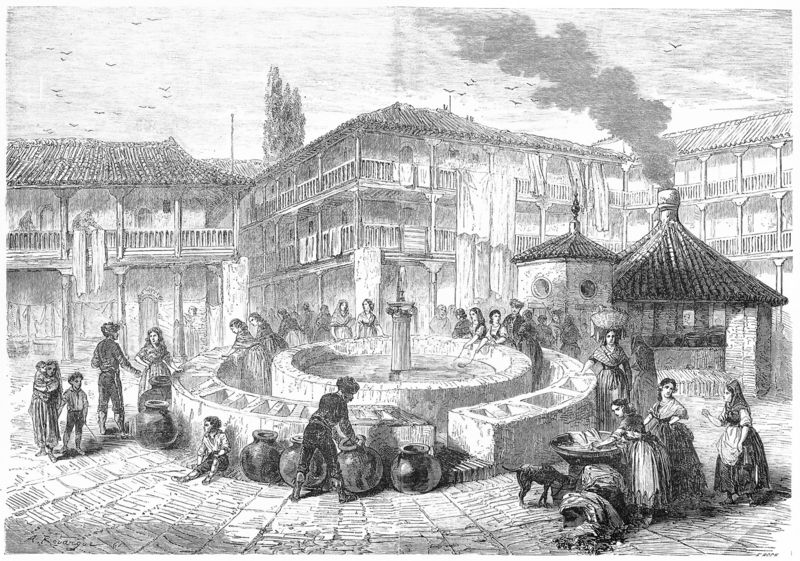
The inhabitants of tenement courtyards have long symbolized the common people of the cities—the urban proletariat. There lived bricklayers, blacksmiths, carpenters, weavers, bleachers, cart drivers, laundresses, ironers, seamstresses, maids, shoemakers—many of whom had their own shop in the courtyard and lived off its clientele—and countless other trades. Perhaps for this reason, because they represented the people of Seville both qualitatively and quantitatively, L. Montoto, when writing about the "Popular Customs of Seville" at the end of the 19th century, focuses on the life, social relations, trades, festivals, beliefs, and habits of the inhabitants of tenement courtyards. This collection of articles, which first appeared in the journal El Folk-Lore andaluz, was published under the general title "The Tenement Courtyards."
Life in the corral revolved around the patio, the geographical and nerve center of the group of people who lived there. There, they found satisfaction for their need for shelter as well as a response to their social and relational needs. The corral celebrated a child's baptism, witnessed a fight between mothers over their children, criticized or reprimanded the drunkard, the brawler, or the troublemaker, enjoyed themselves together at the celebration of the Cross of May, on Piñata Sunday, at the patron saint's festival, and finally attended the wake, wake, and burial of a neighbor.
Of all the residents of the tenement courtyard, the landlady was undoubtedly the most prominent figure. She and her family occupied one of the rooms near the gate, controlling its opening and closing (when the courtyard had one). She was the owner's representative, whose interests she defended, collecting rents—daily, weekly, or monthly—and even evicting incorrigible deadbeats. She was also the first point of contact in disputes that arose between neighbors for failing to fulfill their assigned duties, such as cleaning the front gate, tending the lights, and drawing water from the well for the washhouse or toilets. She also intervened in disagreements between neighbors and was generally respected due to her power to admit and dismiss tenants.
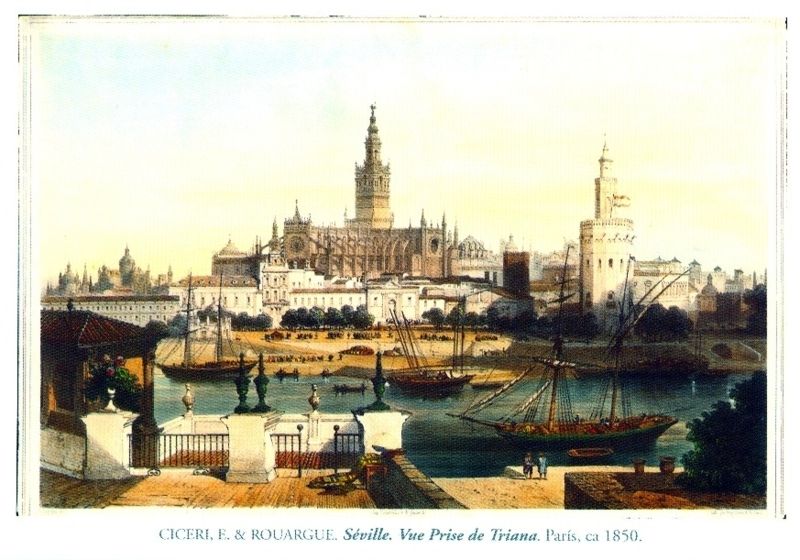
The tenement courtyard appears to be a characteristic form of multi-family housing in Andalusia, although similar forms exist in other parts of the world. Within the Andalusian region, courtyards are found in Seville, Cordoba, Granada, Huelva, Cadiz, Punta Umbría, Arcos de la Frontera, San Fernando, Algeciras, Conil, Olivares, and probably in many other places unknown to us. Of all the many mentioned, Seville ranks first in terms of number, diversity, and persistence. Gómez Zarzuela's 1862 Guide to Seville cites nearly two hundred, and Morales Padrón and colleagues in 1974 were still able to study eighty-one specifically built as courtyards, although many were already in a state of disrepair and slated for demolition. In Seville, Triana is the neighborhood with the highest density concentrated on Pagés del Corro street, although the most famous and one of the largest – there were one hundred and thirteen homes in this century – is the Corral del Conde on Santiago street.
The tenement courtyards, born as an economic and cultural response to an epidemic housing shortage in Andalusian towns and cities, are on the verge of extinction due to the rising value of urban land, a consequence of rampant speculation, and the desire to improve housing conditions. This does not mean that the cultural model has died out. Good examples of this are the "colectivas" (collective housing) of Ciudad Jardín, or the courtyards of the Candelaria neighborhood, both in Seville, which combine comfortable housing with a sense of community. However, economic interests and uniform construction practices seem to have sealed their fate.
Source: “Great Encyclopedia of Andalusia”. Andalusian Cultural Promotions.